
Enduring™ Silica Sand-Based Thermal Energy Storage
NREL-validated technology converting low-cost silica into a 26 GWh long duration thermal battery that outlasts lithium-ion
Revolutionary Energy Storage Technology
Capturing the Future: Why Homerun & NREL’s Enduring System Lead the Next Wave of Energy Storage
As global demand for AI and hyperscale data centers explodes, the need for reliable, scalable, and cost-effective long-duration energy storage has become critical. AI infrastructure faces unprecedented power demands and heat management challenges that traditional batteries and cooling systems simply cannot meet. Homerun, in collaboration with NREL’s groundbreaking Enduring thermal energy storage system, delivers a transformative solution: using Homerun’s, low-cost silica sand, the system stores clean energy as heat at up to 1200°C, ready to be discharged when and where it’s needed most. With round-trip efficiencies matching or exceeding other stationary storage options, and a durability that far outlasts chemical batteries, this technology is engineered for the relentless uptime and energy spikes of next-generation data centers and AI clusters.
Most importantly, Homerun’s strategic buildout offers unmatched scalability for utilities, industry, and digital infrastructure and positions the company at the center of the grid resilience revolution, a market forecast to surge as data centers race to support AI’s exponential growth. The window for leadership is now: Enduring is poised to become the industry standard, while legacy solutions struggle to keep pace with evolving energy needs. For operators, investors, and partners, Homerun’s silica-based system means future-proof performance, lower costs, ultra-clean operation, and long-term value as energy transitions accelerate worldwide.
Partnership
United States Department of Energy’s National Renewable Energy Laboratory (NREL)
Module Scale
135 MW power / 26 GWh storage per unit
Temperature Range
Up to 1,200°C suitable for industrial heat & power
Storage Cost
< US $10/kWh-thermal — one-tenth of Li-ion LDES
The Enduring System
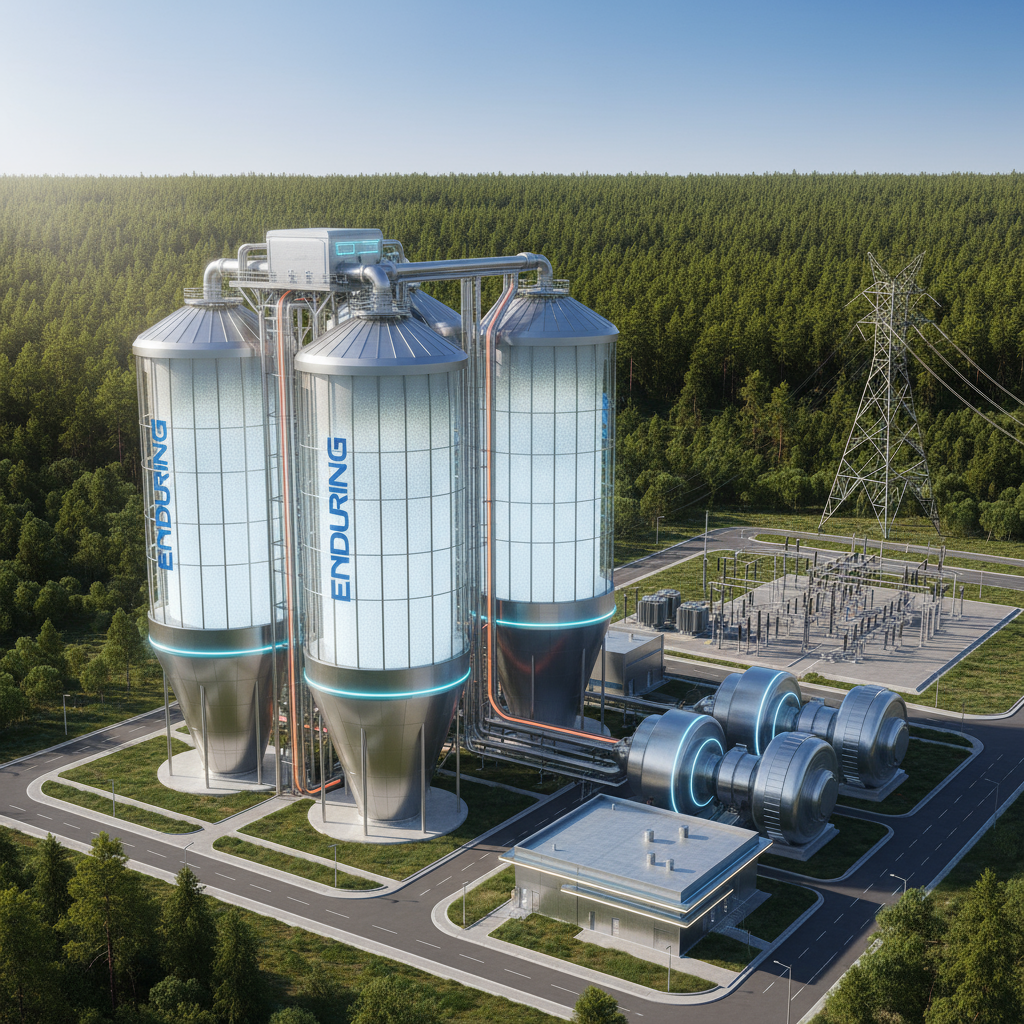
The Enduring system separates inexpensive silica-sand storage from power-cycle hardware, enabling economical scaling beyond 100 hours without the geographic limits of pumped hydro or compressed-air plants.
Circulating particles provide higher heat capacity and efficiency than incumbent air-based TES, while eliminating fire risk associated with graphite blocks.
Key Applications & Commercialization

Jiri Skopek has been engaged as Homerun’s Corporate Development Advisor for the strategic development and commercialization of the Company’s Enduring Long Duration Energy Storage System (LDES) integrated with Homerun Energy’s Energy Management System (EMS).
Jiri Skopek added: “The convergence of materials, energy systems, and digital intelligence defines the future of clean power. Homerun’s platform uniquely integrates long-duration storage, silica technologies, and AI intelligence to deliver solutions capable of transforming industrial and grid-scale energy applications.”
Jiri’s Biography
Jiri Skopek is an architect, smart community planner, and leader in smart and sustainable development whose work has shaped buildings, communities, and national standards for more than three decades. As Managing Director of Sustainability at JLL, he advised corporate clients on greening large portfolios and led the smart-building transformation of federal buildings, a landmark deployment of analytics-driven operations in government real estate.
Utility LDES
Time-shift surplus wind/solar for up to four days
Industrial Heat
135 MW power / 26 GWh storage per unit
Modular Microgrids
1-10 MW units for mines, data centers, or remote communities
Technology Comparison
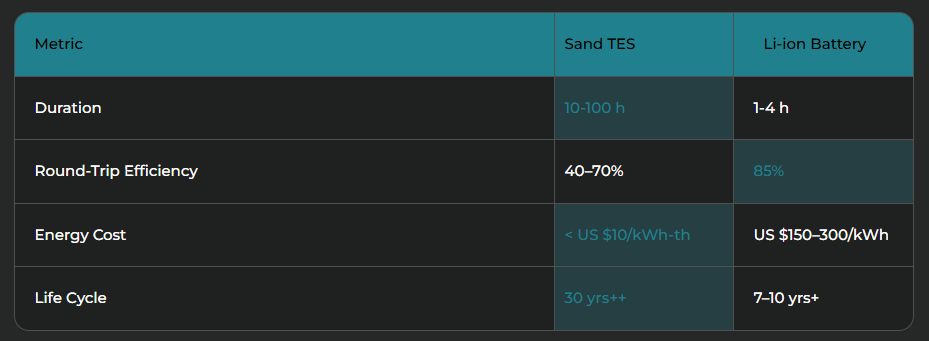
*Enduring achieves 40-70% round-trip efficiency for electricity-to-electricity cycles, which is competitive with compressed air energy storage (40-60%) and pumped hydro (70-85%). While lower than lithium-ion batteries (85%), the critical difference is that Enduring’s ultra-low storage cost ($4-10/kWh vs. $300+/kWh for batteries) makes it economically superior for durations beyond 4-8 hours. Additionally, when deployed for combined heat and power or direct industrial heat applications, Enduring’s overall system efficiency is much higher because waste heat is captured and utilized rather than discarded. With spinning reserve capability at hot start, Enduring can respond in minutes to synchronize with grid demand, matching the response time of traditional peaker plants.
Investment Opportunity
With patents, pilot-ready hardware and captive silica feedstock, Homerun is positioned to commercialize long-duration storage that de-links renewable penetration from grid reliability, offering investors exposure to a breakthrough climate technology platform.
Powered By EmbedPress
Frequently Asked Questions:
The Enduring system represents 15 years of sustained R&D with $20 million in total funding supported by the U.S. Department of Energy, including $2.83 million from ARPA-E. This substantial, long-term government backing demonstrates both the technology’s strategic importance and rigorous validation through one of the world’s most demanding energy innovation programs. The multi-year development timeline has resulted in five awarded patents, eight published journal papers, and a book chapter, proof of deep technical maturity and commercial readiness.
Enduring’s particle-based thermal energy storage has transformative advantages over competitors like Rondo (firebricks), Antora (graphite), and air-based systems (Brenmiller, Magaldi, MOTES). First, silica sand costs only $30-40 per ton, delivering energy storage at less than $10/kWh—dramatically cheaper than firebricks (over $1/kg) and far safer than graphite systems that carry fire hazards. Second, circulating sand particles over heat exchangers allows for much higher heat capacity and efficiency compared to incumbent technologies that circulate air. Third, Enduring separates storage from charging/discharging equipment, enabling free scaling of storage capacity at minimal incremental cost, a critical advantage that other systems can’t match. Finally, silica sand operates safely across an extraordinary temperature range from below 0°C to over 1,200°C, making it the most versatile thermal storage medium available.
Enduring delivers the lowest energy storage cost in the long-duration sector at $4-10/kWh, which is 15-75x cheaper than compressed air energy storage ($150-300/kWh) and more than 6x cheaper than pumped hydro (>$60/kWh). While lithium-ion and flow batteries offer higher round-trip efficiency, their storage costs remain prohibitively expensive for durations beyond a few hours. Enduring’s power system costs of $700-1,500/kW are also highly competitive with compressed air and significantly better than flow batteries ($500/kWh). This unbeatable cost structure positions Enduring as the only economically viable solution for 10-100+ hour storage durations required by utilities and industrial customers.
AI data centers represent one of the fastest-growing energy loads globally, requiring both massive electricity and advanced thermal management. Enduring’s modular 1-10 MWe heat/power units can be deployed on-site or off-grid to provide combined heat and power, perfectly matching data center operational requirements. The system’s ability to store electricity during low-cost periods and discharge during peak demand or grid instability ensures uninterrupted operations, critical for AI workloads that cannot tolerate downtime. Additionally, Enduring can integrate with nuclear small modular reactors (SMRs) like the BWRX-300, providing baseload power with flexible peak response, making it the ideal backbone for next-generation digital infrastructure.
Enduring offers two deployment options: utility-scale units delivering 10-100 MWe with over 100 MWh thermal storage for 10-100 hour durations, and modular drop-in units of 1-10 MWe for distributed industrial heat and power. A single module can provide 135 MW of power with 26 GWh of storage capacity. The breakthrough innovation is that storage capacity can be freely scaled by simply adding more sand silos without increasing heat exchanger or power generation costs enabling utilities to expand capacity economically as demand grows. This flexibility gives Enduring unmatched deployment versatility from island communities (1-10 MWe micro modular reactors) to utility grids (100-300 MWe).
Industrial heat accounts for 85 EJ of global energy demand annually, with 74% currently supplied by fossil fuels (coal, natural gas, oil). Enduring’s sand-based thermal storage covers the full temperature range from below 0°C to over 1,000°C, enabling it to supply carbon-free heat to virtually all industrial processes below 1,200°C, including low-temperature applications (boiling, sterilizing, drying), medium-temperature (distilling, dyeing), and high-temperature (material transformation). This positions Enduring to target 973 million metric tons of CO2 emissions from U.S. industrial heat alone, with even larger global decarbonization potential. No competing technology can match this temperature range or cost-effectiveness for industrial applications.
Enduring achieves 40-70% round-trip efficiency for electricity-to-electricity cycles, which is competitive with compressed air energy storage (40-60%) and pumped hydro (70-85%). While lower than lithium-ion batteries (85%), the critical difference is that Enduring’s ultra-low storage cost ($4-10/kWh vs. $300+/kWh for batteries) makes it economically superior for durations beyond 4-8 hours. Additionally, when deployed for combined heat and power or direct industrial heat applications, Enduring’s overall system efficiency is much higher because waste heat is captured and utilized rather than discarded. With spinning reserve capability at hot start, Enduring can respond in minutes to synchronize with grid demand—matching the response time of traditional peaker plants.
Enduring is protected by five awarded patents (and growing) covering the core system and critical components, providing strong intellectual property barriers to competition. This patent portfolio, combined with eight published peer-reviewed journal papers and a book chapter, establishes NREL and Homerun as the recognized technology leaders in particle-based thermal energy storage. The 15-year R&D timeline and rigorous DOE oversight have validated every aspect of the technology, giving investors confidence that Enduring’s innovations are defensible, proven, and ready for commercial deployment.
Enduring is designed as the perfect complement to variable renewables like solar and wind, storing excess electricity when generation is high and discharging during multi-day gaps or peak demand periods. This enables large-scale grid integration of renewables while increasing their economic value. For nuclear integration, Enduring acts as a thermal battery that stores waste heat or surplus electricity from small modular reactors (SMRs) during low-demand periods and releases it during peaks decoupling electricity and heat production from consumption. This enhances grid resilience, reduces curtailment, eliminates the need for fossil fuel backup, and improves the utilization of district heating networks. Enduring’s flexibility makes it the only storage technology capable of supporting utilities, industries, data centers, and remote communities across the entire energy transition.
The global energy storage market is at an inflection point: long-duration storage demand is projected to reach 160 TWh annually by 2040, yet installed capacity is below 1% of requirements. Enduring has completed 15 years of development, achieved full technical validation, secured five patents, and proven cost and performance targets under ARPA-E oversight, making it one of the most mature and de-risked technologies in the sector. With AI data centers, industrial decarbonization, and renewable grid integration driving unprecedented energy demand, Enduring is positioned to capture significant market share in a multi-trillion-dollar opportunity. Competitors using firebricks, graphite, or air-based systems cannot match Enduring’s cost, safety, scalability, or temperature range. The window for early-mover advantage is now, before mass deployment begins and market leadership is established.
Homerun’s low-iron silica sand is not just a commodity input, it’s a critical strategic differentiator that directly enables Enduring’s superior cost and performance. While generic silica sand costs $30-40/ton, Homerun’s high-purity, low-iron grade is specifically suited to Enduring’s demanding thermal cycling requirements, where impurities like iron oxide can cause degradation, color shifts, and reduced thermal conductivity over thousands of charge-discharge cycles. NREL has rigorously tested and validated Homerun’s silica feedstock as the optimal material for Enduring, confirming that it meets stringent specifications for long-duration thermal storage applications. Critically, the Enduring system architecture includes built-in purification mechanisms as sand circulates through the charging and discharging heat exchangers, impurities naturally segregate and can be continuously removed, ensuring that even if feedstock varies slightly, the active sand bed maintains purity and peak performance throughout the system’s operational life. This self-cleaning capability means Homerun’s silica advantage compounds over time: Homerun supplies the foundational low-iron material, NREL’s design validates its suitability, and the system itself maintains and enhances sand quality during operation. This tight vertical integration—from resource extraction through validated material specifications to engineered purification within the system—positions Homerun as the essential long-term partner for Enduring deployment at scale, creating durable competitive moats and recurring revenue streams as global adoption accelerates
 English
  Portuguese